
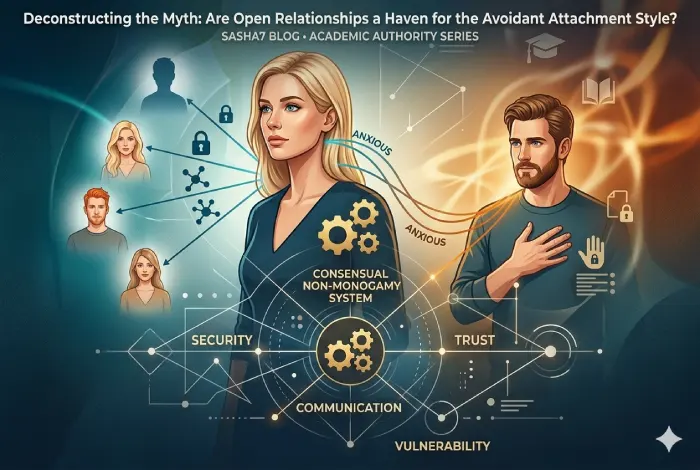
When exploring consensual non-monogamy, open marriages, or alternative relationship dynamics, mainstream culture often relies on a highly simplistic, knee-jerk assumption: “People who want open relationships must just be afraid of true intimacy.”
In clinical psychology, this behavioral pattern is known as having an avoidant attachment style. The prevailing cultural narrative suggests that by multiplying romantic or sexual partners, an avoidant individual can effectively dilute the emotional intensity of their primary bond. In theory, spreading emotional risk across multiple connections keeps anyone from getting close enough to cause genuine vulnerability or hurt.
However, when we extract the conversation from internet forums and ground it in peer-reviewed behavioral science, that myth completely unravels. The empirical data reveals a striking paradox: while open relationship structures are highly attractive to avoidant personalities in theory, they require a suite of psychological skills that are profoundly antithetical to the avoidant coping mechanism in practice.
The Four Adult Attachment Styles: A Quick Diagnostic Breakdown
To evaluate why open systems fail to serve as a sustainable haven for avoidant individuals, we must first establish how adult attachment styles operate. Think of your attachment style as your relationship thermostat. Developed in early childhood and carried into adult romantic partnerships, it dictates our automated behavioral responses to relational safety, intimacy, and perceived threat.
Secure Attachment (“The Confident Partner”)
- The Core Mindset: “I am safe, you are reliable, and we can navigate both closeness and space together.”
- How They Act: Secure individuals are comfortable with emotional intimacy and entirely tolerant of autonomy. They don’t interpret a partner’s need for space as impending abandonment, nor do they interpret close emotional vulnerability as a trap. They communicate needs clearly and process conflicts without defensive posturing.
Anxious-Preoccupied Attachment (“The Vigilant Partner”)
- The Core Fear: Abandonment, rejection, and being replaced.
- How They Act: Anxiously attached individuals possess a hyperactivated relationship threat-detection system. They are continuously on the lookout for signs that their partner is pulling away or losing interest. When a threat is perceived, their defense mechanism is to move closer—demanding intense reassurance, text messaging frequently, or experiencing acute waves of jealousy to force the connection back into alignment.
Dismissive-Avoidant Attachment (“The Independent Partner”)
- The Core Fear: Loss of autonomy, control, and being emotionally suffocated.
- How They Act: Avoidant individuals equate deep vulnerability with a dangerous loss of freedom. When a relationship demands intense emotional exposure or encounters high-stakes conflict, their automated defense mechanism is deactivation. They pull away, construct psychological walls, suppress their distress, and retreat into absolute self-reliance, preferring to deal with problems completely alone.
Fearful-Avoidant Attachment (“The Conflicted Partner”)
- The Core Fear: Both intimacy and abandonment simultaneously.
- How They Act: Also known as disorganized attachment, this is a volatile mix of both anxious and avoidant tendencies. These individuals crave love and closeness deeply but are terrified of trusting anyone because they assume they will eventually get hurt. They live in a continuous “push-pull” cycle—drawing a partner close, panicking that it’s too dangerous, and then abruptly pushing them away.
The Paradox: Why Open Systems Fall Apart for Purely Avoidant Styles
On paper, non-monogamous configurations appear to be a bespoke match for the dismissive-avoidant individual. A relationship structure that implicitly rejects traditional enmeshment and permits independent exploration seems to validate their pursuit of hyper-independence. Indeed, empirical research confirms that avoidant individuals express significantly higher abstract interest in consensual non-monogamy (CNM) than secure or anxious individuals.
Yet, a critical divergence occurs when transitioning from abstract interest to operational execution. When clinical researchers evaluate individuals who are successfully maintaining stable, long-term open relationships, avoidant individuals are statistically underrepresented. Instead, successful open systems are overwhelmingly populated by individuals with exceptionally high baselines of secure attachment.
The reason for this structural failure comes down to what clinicians call relational maintenance overhead. Traditional monogamy relies heavily on rigid, socially institutionalized boundaries to preserve stability. Monogamy dictates parameters explicitly: clear rules around physical exclusivity, time allocation, and focal attention. This external scaffolding allows an avoidant person to navigate a relationship without being forced to continuously articulate their internal emotional architecture.
Consensual non-monogamy removes this external scaffolding entirely. When boundaries are flexible and custom-built, safety cannot be assumed—it must be actively and verbally engineered through relentless communication. To operate an open system successfully, partners must engage in continuous vulnerability, radical transparency, subtle emotional tracking, and highly sophisticated conflict resolution.
For a truly avoidant person, the operational reality of an open relationship is an absolute emotional minefield. When a system triggers a partner’s insecurity, the avoidant partner’s default response—withdrawing, compartmentalizing, and stonewalling—stifles the dynamic.
They do not find a haven; instead, they find a system that demands the precise emotional currency they are least equipped to pay. If your primary partner goes on an outside date, you cannot simply shut down when they return home; you must actively discuss boundaries, process unexpected stabs of jealousy, and reassure one another. Monogamy actually allows avoidant types to hide much easier than non-monogamy does.
Clinical Takeaway & Relationship Architecture
From a clinical and therapeutic perspective, open relationship models are neither inherently superior nor pathologically inferior to monogamy. However, they act as an emotional magnifier. If a couple decides to open their relationship to escape a foundational intimacy block or an ongoing conflict, the structural change will accelerate the breakdown rather than cure the root issue.
For an individual recognizing anxious or avoidant patterns within an open structure, success relies on creating explicit, conscious relational scaffolding. Avoidant partners must commit to remaining present during high-stress boundary discussions rather than using outside encounters as an escape hatch. Concurrently, anxious partners require structured, reliable reassurance and deliberate reconnection rituals to validate their primary bond after outside interactions occur.
Moving Beyond the Pop-Psychology Narrative
The cultural diagnostic that labels alternative relationship styles as a definitive badge for the “commitment-phobic” is flatly incorrect. Far from being a refuge for the avoidant, high-functioning non-monogamy is an advanced relational framework that demands an elite level of secure attachment traits. Without an intrinsic capacity to trust, self-soothe, communicate transparently, and lean into vulnerability when boundaries shift, an open system will inevitably collapse under its own operational weight.
Peer-Reviewed Bibliography
Mogilski, J. K. (2025). How do people maintain consensual non-monogamy? An international development and validation of the Multiple Relationships Maintenance Scale. The Journal of Sex Research, Advance online publication. https://pubmed.ncbi.nlm.nih.gov/41840193/
Moors, A. C., Ryan, W., & Chopik, W. J. (2019). Multiple loves: The effects of attachment with multiple concurrent romantic partners on relational functioning. Personality and Individual Differences, 147, 102–110. https://doi.org/10.1016/j.paid.2019.04.023
Simpson, J. A., & Rholes, W. S. (2017). Adult attachment, stress, and romantic relationships. Current Opinion in Psychology, 13, 19–24. https://doi.org/10.1016/j.copsyc.2016.04.006
Advanced Behavioral Insights & Analysis
To better understand the complex intersection of modern evolutionary biology, relationship psychology, and contemporary digital behavior, explore our deep-dive scientific analyses below:
- The 80/20 Rule in Modern Relationships – Applying the Pareto Principle to intimacy: Why partners risk an entire 80% foundation of stability to pursue a missing 20% of novel validation.
- The Clinical Roots and Causes of Infidelity – Deconstructing the complex matrix of emotional, psychological, and circumstantial factors that cause individuals to step outside their primary partnership.
- The Reddit Affair Ecosystem and Digital Behavior – A comprehensive big-data analysis of online affair communities, mapping the real-world motivations, behavioral patterns, and psychology of anonymous users.
- The Coolidge Effect and Evolutionary Psychology – An in-depth look at how biological dopamine habituation and ancestral mating blueprints drive the pursuit of physical novelty.
- The Monogamy Cap & Relational Suffocation – Analyzing Eli Finkel’s “Suffocation Model” of marriage: How demanding an “all-in-one” partner places an artificial ceiling on human fulfillment and burns out modern relationships.