

Artificial intelligence is increasingly becoming part of everyday dating — helping people write profiles, compose messages and navigate difficult conversations.
But what happens when AI enters a relationship that is supposed to remain secret?
To find out, Sasha7 surveyed 1,087 users of its discreet-dating platform about whether and how they use artificial intelligence in connection with extramarital relationships.
The results suggest AI is already playing a meaningful role.
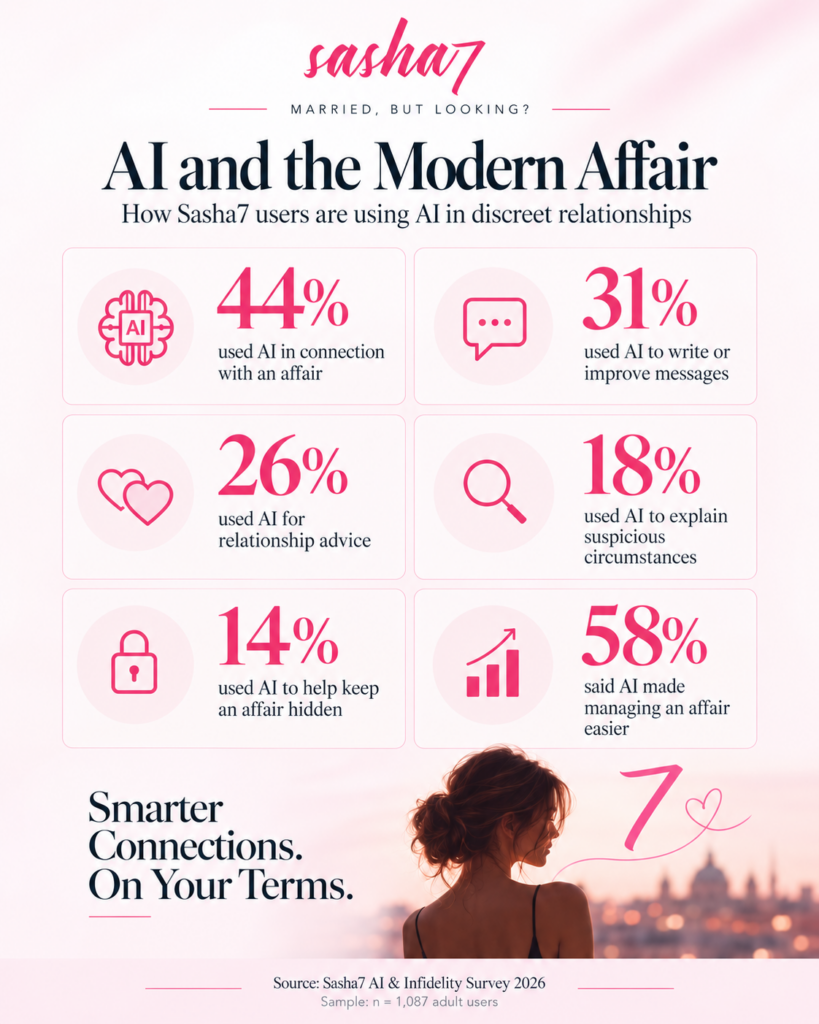
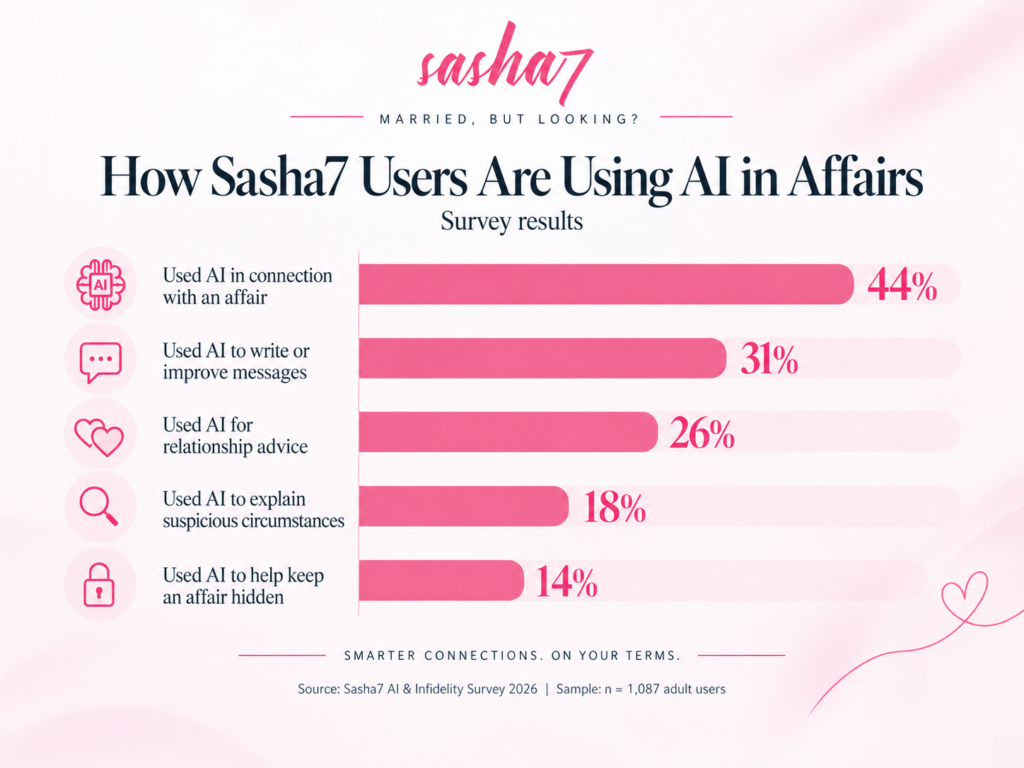
44% of respondents said they had used an AI tool such as ChatGPT, Gemini or Claude in connection with an affair or discreet relationship.
Even more strikingly, 18% said they had used AI to help explain suspicious circumstances to a spouse or partner, while 14% said they had used AI specifically to make a discreet relationship harder to discover.
Key Findings
🔹 44% have used AI in connection with an affair or discreet relationship.
🔹 31% have used AI to write or improve messages to someone they were romantically or sexually interested in.
🔹 26% have used AI for advice about an affair or discreet relationship.
🔹 18% have used AI to help explain suspicious circumstances to a spouse or partner.
🔹 14% say they have used AI specifically to make a discreet relationship harder to discover.
🔹 58% of respondents who had used AI said it made managing a discreet relationship easier.
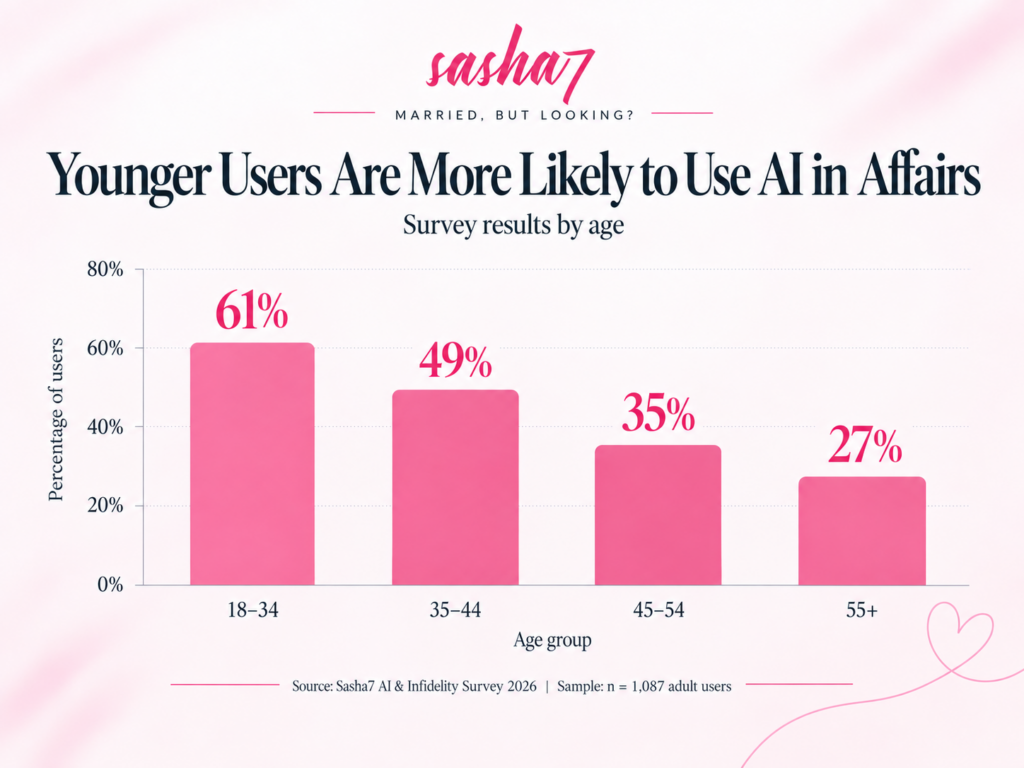
🔹 61% of respondents aged 18–34 had used AI in connection with an affair, compared with 27% of respondents aged 55+.
AI Is Becoming a Relationship Assistant — Including for Affairs
The most common use of AI was relatively ordinary.
Among respondents who had used AI in connection with a discreet relationship, messaging was the dominant use case.
What are people using AI for?
Among respondents who reported using AI:
- 70% had used it to write, rewrite or improve messages
- 59% had asked AI what they should say or how they should respond
- 48% had used it for relationship advice
- 34% had used it while planning a date or encounter
- 41% had used it to think through scheduling or relationship complications
- 32% had used it to help explain suspicious circumstances to a spouse or partner
- 25% said they had used it specifically in an effort to make the relationship harder to discover
Respondents could select more than one answer.
The findings suggest that AI’s role is not limited to generating flirtatious messages. For a meaningful minority of respondents, it has become a private sounding board for navigating the logistical and interpersonal complexity surrounding an affair.
Nearly One in Five Say AI Has Helped Them Explain Suspicious Situations
One of the most striking findings was that 18% of all respondents said they had asked AI for help explaining a situation connected to an affair to their spouse or long-term partner.
The survey did not ask respondents to describe the specific explanation they generated.
However, the result highlights a relatively new role for generative AI: acting as an always-available adviser during sensitive interpersonal situations.
Among respondents under 35, 24% reported having done this, compared with 11% of respondents aged 45 and older.
14% Say They Have Used AI to Help Keep an Affair Hidden
Respondents were also asked directly:
“Have you ever used an AI tool specifically to make an affair or discreet relationship harder for your spouse or partner to discover?”
14% answered yes.
A further 7% selected “prefer not to say.”
The survey did not ask respondents for concealment techniques or specific methods.
Instead, the question was intended to measure whether AI is beginning to play a broader role in maintaining secrecy around extramarital relationships.
Younger Respondents Are Using AI Far More Frequently
Age produced one of the clearest differences in the survey.
Respondents who had used AI in connection with an affair:
18–34: 61%
35–44: 49%
45–54: 35%
55+: 27%
This pattern broadly reflects the greater adoption of generative AI among younger internet users, but its presence within discreet dating suggests that AI-assisted relationship behaviour may become increasingly common as today’s younger users age.
Does AI Actually Make Having an Affair Easier?
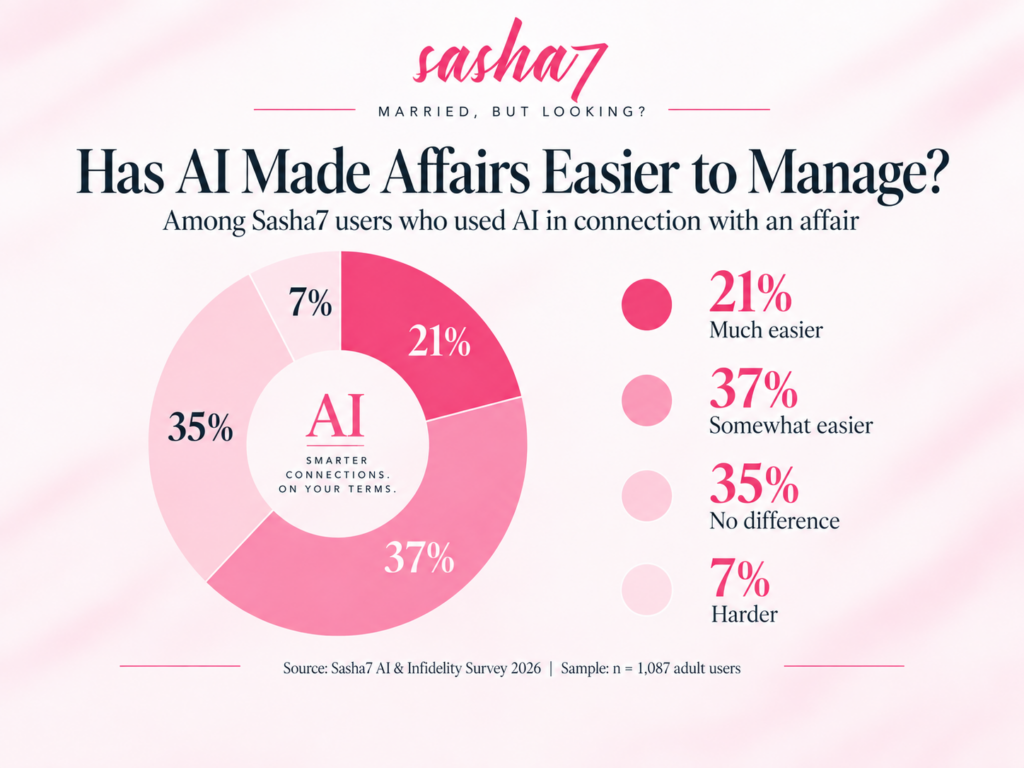
Among respondents who had used AI in connection with a discreet relationship:
21% said AI made it “much easier.”
37% said it made it “somewhat easier.”
35% said it made little or no difference.
7% said it made the situation more complicated.
Combined, 58% said AI had made managing a discreet relationship easier.
AI-Written Romance Raises Another Question: Who Is Really Talking?
AI’s involvement also creates questions around authenticity.
Among respondents who had used AI to compose romantic messages, only 46% said a heavily AI-edited message still felt completely like their own words.
39% said it felt only partly like their own message, while 15% said an extensively AI-written romantic message did not really feel like it came from them.
That creates an unusual paradox.
AI may make intimate communication easier while simultaneously making it less personal.
Will AI Change Infidelity?
Respondents overwhelmingly expected AI’s role to grow.
When asked whether artificial intelligence would make extramarital affairs easier to conduct during the next five years:
64% said yes.
17% said no.
19% were unsure.
Generative AI is unlikely to create the motivations that lead people to seek relationships outside their primary partnership.
What it may change is the infrastructure surrounding those relationships: communication, decision-making, advice and the ability to manage complicated interpersonal situations.
Methodology
Sasha7 surveyed 1,087 adult users of its discreet-dating platform.
Responses were collected anonymously between July 1st and September 1st 2026.
Participation was voluntary, and respondents were not required to answer every question.
Respondents were located in the United States, Australia, and Canada.
Because respondents were users of a discreet-dating platform, the sample should not be interpreted as representative of the general population. The survey was specifically designed to examine AI use among people using a platform intended for discreet relationships.
Percentages may not total 100% because of rounding and, for questions allowing multiple responses, because respondents could select more than one option.
For Media
Journalists interested in additional survey data, charts, methodology details or comment can contact:
[email protected]