
What happens when you can tell your spouse almost anything, except who you voted for?
For some couples, political disagreements are little more than lively dinner-table debates. For others, they have become something far more personal, creating arguments, resentment, and an uncomfortable feeling that the person sharing their bed no longer understands them.
As Americans head to the polls for the November 3 midterm elections, and Brazil comes to terms with its October 25 presidential runoff, political polarization is once again dominating conversations.
But some of the most consequential disagreements may be happening far from the campaign trail, behind closed doors.
Research suggests political differences can affect relationship stability. A Sasha7 survey explores a more provocative question: could the emotional distance created by political conflict become one of the reasons people seek intimacy outside their relationships?
The secret ballot isn’t always the only secret
During the 2024 U.S. presidential election, YouGov polling revealed that approximately one in eight women had voted differently from their romantic partner without telling them. Around one in ten men reported doing the same.
The finding challenges the assumption that people sharing a home necessarily share political beliefs.
And secret voting isn’t the same as cheating. Voting is a private right, and nobody owes their partner an account of what happens inside the voting booth.
Still, the reasons people conceal their political preferences can tell us something about the dynamics of a relationship.
Some simply value their privacy. Others may want to avoid another exhausting argument. And some might genuinely fear how their partner would react.
For the latter group, a secret vote can be a symptom of something larger: a relationship in which expressing disagreement no longer feels emotionally safe.
The important distinction isn’t between voting honestly and dishonestly. It’s between a couple that can tolerate differences and one where disagreement has become so uncomfortable that silence feels easier.
Political differences can predict relationship trouble
An August 2026 working paper from researchers at the University of California, Berkeley offers striking evidence of how politics can intersect with relationship stability.
Analyzing voter registration data associated with approximately 60 million couples between 2014 and 2024, researchers found that politically mismatched couples were more than 14% less likely to remain together from one election cycle to the next.
In absolute terms, that amounted to a difference of about 0.61 percentage points over two years.
The research also identified increased vulnerability among politically mismatched couples during particularly contentious political events.
A separate study published in the Journal of Personality and Social Psychology, examining 11 datasets involving more than 4,000 individuals, found a smaller but consistent association between political differences and lower relationship quality.
Importantly, the researchers also found evidence that appreciation and perspective-taking could help buffer these effects.
Political disagreement, in other words, isn’t necessarily a relationship death sentence. How couples handle it matters.
And most couples aren’t on opposite political extremes. A 2026 YouGov survey found that 69% of partnered Americans mostly or completely agreed with their partner politically. Another 23% reported a mixture of agreement and disagreement, while 5% mostly or completely disagreed.
That leaves a meaningful minority navigating political tensions inside their relationships.
When political disagreements become emotional distance
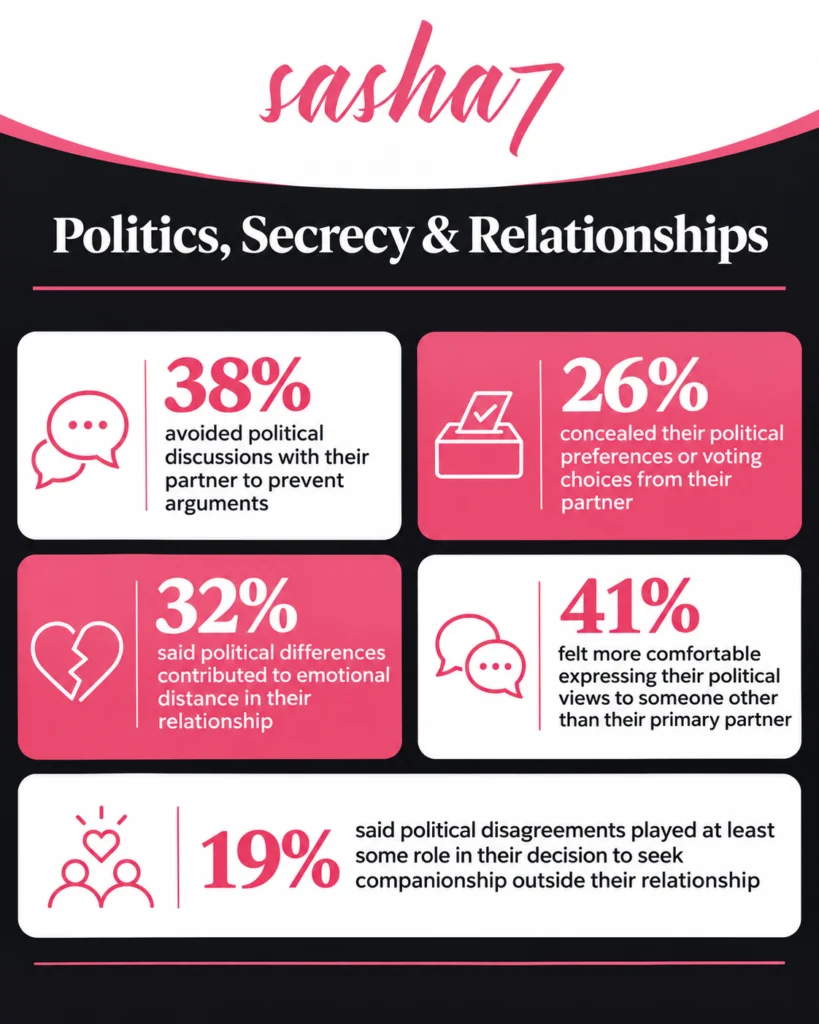
A survey of 1,800 U.S. members of Sasha7, an international platform for discreet connections, offers a potential window into how political tensions are experienced by people seeking companionship outside conventional relationships.
- 38% reported avoiding political discussions with their partner to prevent arguments.
- 26% reported concealing their political preferences or voting choices from their partner.
- 32% said political differences had contributed to emotional distance in their relationship.
- 41% said they felt more comfortable expressing their political views to someone other than their primary partner.
- 19% said political disagreements had played at least some role in their decision to seek companionship outside their relationship.
The distinction between avoiding an argument and feeling emotionally disconnected is important.
Many couples choose not to discuss politics because they recognize that their differences aren’t worth fighting about. That can be a perfectly reasonable arrangement.
Problems may emerge when political disagreement becomes a stand-in for deeper questions about values, identity, respect, or the future of the relationship.
A disagreement over taxes might be easy to compartmentalize. A disagreement over reproductive rights, religion, immigration, or the treatment of particular communities might feel much more personal.
When someone begins to believe their partner fundamentally rejects their values, the conflict can extend far beyond politics.
And if they stop feeling understood at home, feeling understood somewhere else may become increasingly appealing.
From the ballot box to the bedroom
There is a tempting theory that telling a small lie about voting makes it psychologically easier to tell bigger lies later.
But the connection between secretly voting for a different candidate and subsequently having an affair has not been established by the research cited here.
A more plausible explanation involves emotional disconnection.
Consider someone who has spent months listening to their spouse express political opinions they strongly oppose.
Rather than challenge those opinions and risk another argument, they stay quiet. Eventually, they stop sharing their thoughts about politics altogether.
Over time, they may find themselves avoiding other conversations too.
Then they meet someone who shares their perspective, or simply listens without judgment.
The attraction isn’t necessarily physical at first. It might begin with the relief of being able to speak openly.
That feeling can be powerful, particularly when someone has been missing it in their primary relationship.
The appeal of an outside connection may be less about finding someone more attractive and more about finding someone around whom they can feel like themselves.
This is one possible pathway through which political conflict could contribute to emotional infidelity or the pursuit of an affair. It is not proof that politics directly causes cheating.
The search for someone who understands
Sasha7 finding show that 41% of respondents felt more comfortable sharing political beliefs with someone other than their primary partner would be particularly interesting if supported by real responses.
It raises the possibility that ideological compatibility may sometimes become a form of emotional intimacy.
Someone who shares your political beliefs doesn’t necessarily make a better romantic partner. Yet feeling heard, respected, and understood can create a sense of closeness.
And the desire for that closeness may be particularly strong among people whose existing relationships are already strained.
The 19% finding would also deserve careful interpretation.
It wouldn’t mean political differences caused one in five respondents to have an affair. It would mean that those respondents identified political disagreement as at least one factor influencing their decision to seek an outside connection.
That distinction matters because infidelity rarely has a single explanation.
Sexual dissatisfaction, loneliness, unmet emotional needs, novelty, opportunity, and long-standing relationship problems may all play a role.
Politics could be another piece of that puzzle.
From Brazil to the United States: A divide that crosses borders
The relationship between political identity and personal life is not exclusively American.
Brazil’s October 25 presidential runoff, in which Luiz Inácio Lula da Silva defeated Flávio Bolsonaro with 51.79% of valid votes, followed an intensely competitive campaign.
The U.S. midterms, held just nine days later, provide another moment when political loyalties may become highly visible.
Although the political circumstances differ between the two countries, both offer opportunities to examine whether election-related tensions affect how couples communicate.
For Sasha7, which serves members across multiple countries, the question is especially relevant.
Does political disagreement simply create arguments? Or can it contribute to emotional dissatisfaction serious enough that someone considers relationships outside their partnership?
The answer requires more research, ideally comparing respondents across countries while accounting for their different social and political environments.
One thing is already clear from existing research: politics is not always something couples can leave at the front door.
Does a secret vote lead to a secret affair?
Not necessarily.
A private vote is an expression of personal autonomy. An extramarital affair involves an entirely different set of relationship boundaries and potential consequences.
Treating the two as equivalent would miss the point.
What they can sometimes have in common is a broader environment of secrecy, avoidance, or emotional disconnection.
The real warning sign may not be that someone votes differently from their spouse.
It may be that they no longer feel comfortable telling their spouse what they believe.
A healthy relationship doesn’t require political uniformity. People can disagree strongly about public policy and still maintain trust, affection, and mutual respect.
But when disagreements begin eroding those foundations, the consequences can extend into other areas of the relationship, including intimacy.
And for someone already feeling lonely or misunderstood, the prospect of a connection where they don’t have to hide their opinions may carry an unexpected appeal.
The most consequential political divide in a relationship may not be between Democrats and Republicans, or between the Brazilian left and right. It may be the growing distance between two people who have stopped feeling understood by each other.
About this research
Sasha7 survey: 1,800 U.S. Sasha7 members aged 18 and older.
Independent research and sources:
- UC Berkeley, August 2026: Politically Mismatched Couples Are More Likely to Break Up
- Gordon, Luciani & From, Journal of Personality and Social Psychology: I Love You but I Hate Your Politics
- YouGov, September 2026: Political Agreement in Personal Relationships
- The Washington Post, November 2024: Secret Voting Among Romantic Partners
- Agência Brasil, October 2026: Brazil’s Presidential Election Result