
We live in a culture that romanticizes lifelong, absolute monogamy as the default setting for human relationships. We are taught that if you truly love someone, your eyes, your mind, and your physical desires will naturally lock onto them—and only them—forever.
When a partner strays, society’s immediate diagnosis is that the relationship was fundamentally broken, that love had vanished, or that the unfaithful partner possesses a core moral defect.
But clinical psychology and evolutionary biology tell a far more nuanced story.
Often, infidelity has very little to do with a lack of love or a broken home. Instead, it is driven by a powerful, hardwired neurological phenomenon known as the Coolidge Effect. Understanding this biological blueprint doesn’t just reframe why people stray; it sheds light on the perpetual friction between modern relationship ideals and ancient human biology.
The Origin of the Concept: An Anecdotal History
The term “Coolidge Effect” sounds clinical, but its origin is famously aristocratic. The story goes that in the 1920s, President Calvin Coolidge and his wife, Grace, were touring a government agricultural station in Maryland.
During the tour, Mrs. Coolidge noticed a rooster mating aggressively and frequently. She asked the guide how often this occurred, and the guide replied, “Dozens of times a day, ma’am.”
“Please tell that to the President,” she remarked dryly.
When President Coolidge was told, he paused, looked at the rooster, and asked, “Is it always with the same hen?”
“No, Mr. President, a different one each time,” the guide responded.
Coolidge nodded slowly and said, “Please tell that to Mrs. Coolidge.”
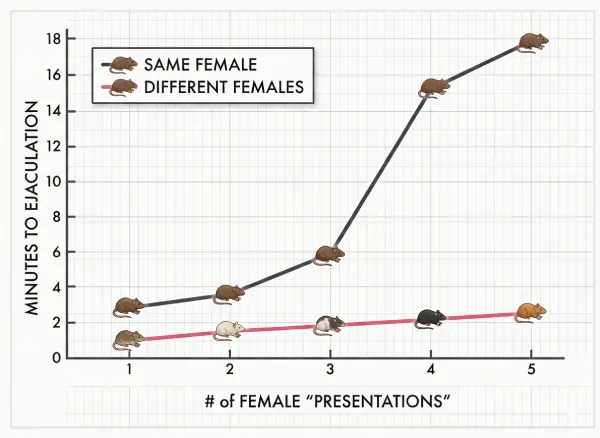
While the anecdote may be apocryphal, behavioral scientists later adopted the name to describe a highly consistent biological phenomenon observed across almost all mammalian species: a dramatic renewal of sexual interest and a near-instantaneous shortening of the refractory period whenever a novel, receptive sexual partner is introduced.
The Neurobiology of Novelty: Dopamine and Habituation
To understand how this applies to human relationships, we have to look beneath the surface of conscious choice and examine the brain’s reward architecture. The primary driver of the Coolidge Effect is dopamine—the neurotransmitter responsible for anticipation, desire, and motivation.
When a relationship is fresh, every interaction is laced with unpredictability. This unpredictability triggers massive spikes of dopamine in the brain’s nucleus accumbens. This is the neurochemical high commonly referred to as the “honeymoon phase.”
However, the human brain is highly sensitive to habituation. Over time, as a relationship matures, predictability increases. Predictability is excellent for emotional security, trust, and co-parenting, but it is the natural enemy of dopamine.
The Neurochemical Paradox: The safer and more predictable a primary relationship becomes, the lower the dopamine response drops during physical intimacy.
This is not a failure of love; it is standard neurological habituation. When a new potential partner enters the equation, the brain perceives an entirely fresh stimulus. The reward pathway resets, firing a torrent of dopamine that mimics the intensity of a brand-new relationship. For many individuals, the urge to cheat is not a conscious decision to hurt their partner, but a subconscious pursuit of this neurochemical reset.
The Evolutionary Blueprint: Why We Are Wired to Stray
From a Darwinian perspective, the Coolidge Effect served a critical evolutionary purpose. For the vast majority of human history, reproductive success was measured solely by genetic diversity and the volume of offspring that survived to reproductive age.
For ancestral males, investing all reproductive energy into a single partner carried genetic risks. If that partner was infertile or if the offspring did not survive, that genetic line ended. Spreading genetic material across multiple partners was an adaptive strategy to ensure survival.
While the evolutionary benefit is less structurally pronounced for females, modern evolutionary psychology shows that women also subconsciously seek genetic diversity or “good genes” through short-term pairings while relying on a stable partner for long-term resource security and protection.
The tension of modern life lies in the fact that while our social, legal, and economic structures have evolved to favor strict monogamy over the last few thousand years, our biological hardwiring has remained largely unchanged for hundreds of thousands of years. We are ancient biological organisms operating within modern societal constraints.
The Infidelity Paradox: Why “Happy” People Cheat
As a specialist in relationships, one of the most common dynamics I observe is the sheer confusion surrounding infidelity in seemingly perfect marriages. Partners will say, “We have a great life, beautiful kids, financial stability, and we genuinely love each other. Why did this happen?”
Renowned psychotherapist Esther Perel frequently notes that when people stray, they aren’t always looking for a new partner—they are often looking for a new version of themselves. They are looking to reconnect with a sense of youth, unpredictability, and raw vitality that routine domestic life naturally erodes.
The Coolidge Effect explains this exact paradox. A person can deeply value their spouse, cherish their family unit, and have no desire to dismantle their life, yet still experience an intense, visceral craving for physical novelty. When the opportunity for novelty presents itself, the ancient dopaminergic drive can easily bypass the logical, long-term planning centers of the prefrontal cortex.
Navigating the Friction: A Pragmatic Modern Approach
Once we strip away the moral panic and view relationships through the lens of biology, the question shifts from “How do we stop people from wanting novelty?” to “How do we manage the human need for novelty responsibly?”
For some couples, standard advice includes trying to introduce novelty within the relationship—changing environments, roleplay, or exploring new fantasies. While this can provide a temporary bump in dopamine, it rarely replicates the deep neurological shift brought on by actual physical novelty.
For other adults, dismantling a multi-decade marriage, facing the emotional trauma of a messy divorce, splitting assets, and uprooting children just to satisfy a biological drive for physical variety is simply too high a price to pay.
This is where the concepts of compartmentalization and modern technology converge.
Instead of blowing up the foundational pillars of their lives, many contemporary adults choose to handle the Coolidge Effect through private, parallel tracks. They recognize that their domestic partnership is an invaluable emotional and structural asset that must be protected, while their need for physical novelty is a separate biological reality that requires a discreet, controlled outlet.
Preserving the Foundation Through Discreet Spaces
Managing this biological friction requires absolute discretion, curation, and control. This is precisely why general-purpose social networks or casual dating apps fail the modern professional; they lack the specific architecture required to keep separate worlds separate.
Platforms like Sasha7 are built specifically to bridge this gap. Designed as a highly secure, private portal rather than just an open social network, Sasha7 provides a curated space where like-minded adults can explore the biological imperative of novelty without disrupting the stability of their primary lives.
By prioritizing deep anonymity, verified privacy, and a community of peers who understand that physical desire and domestic love can exist on completely different tracks, it allows individuals to satisfy the hardwired demands of the Coolidge Effect safely.
We cannot rewrite hundreds of thousands of years of evolutionary biology. We cannot force our brains to stop responding to the dopamine rush of the new. But as rational, modern adults, we can choose how we navigate those desires—protecting the lives we’ve built while honoring the nature of who we are.
Ready to explore a new chapter?
If you are ready to experience the vitality of physical novelty within a completely secure, anonymous environment designed for discerning adults, take control of your desires today. Sign up for a private Sasha7 account here and connect with a community that understands the true balance of modern relationships.
If you are looking to explore these relationship dynamics in a safe, completely discreet environment, see why Sasha7 is legit and review our official quality and privacy report.
References:
Lehmiller, J. (2023). Why Long-Term Partners Might Need Some Sexual Novelty. Psychology Today. https://www.psychologytoday.com/ca/blog/the-myths-of-sex/202311/why-we-crave-sexual-novelty
Fiorino, D. F., Coury, A., & Phillips, A. G. (1997). Dynamic changes in nucleus accumbens dopamine efflux during the Coolidge effect in male rats. The Journal of Neuroscience, 17(12), 4849–4855. https://www.jneurosci.org/content/17/12/4849
Shackelford, T. K. (Ed.). (2022). The Cambridge Handbook of Evolutionary Perspectives on Sexual Psychology. Cambridge University Press. https://www.cambridge.org/core/books/cambridge-handbook-of-evolutionary-perspectives-on-sexual-psychology/mate-poaching/9AB75C1F9D52BDF1E4551F8120352A95
Advanced Behavioral Insights & Analysis
To better understand the complex intersection of modern evolutionary biology, relationship psychology, and contemporary digital behavior, explore our deep-dive scientific analyses below:
- The 80/20 Rule in Modern Relationships – Applying the Pareto Principle to intimacy: Why partners risk an entire 80% foundation of stability to pursue a missing 20% of novel validation.
- The Clinical Roots and Causes of Infidelity – Deconstructing the complex matrix of emotional, psychological, and circumstantial factors that cause individuals to step outside their primary partnership.
- The Reddit Affair Ecosystem and Digital Behavior – A comprehensive big-data analysis of online affair communities, mapping the real-world motivations, behavioral patterns, and psychology of anonymous users.
- The Monogamy Cap & Relational Suffocation – Analyzing Eli Finkel’s “Suffocation Model” of marriage: How demanding an “all-in-one” partner places an artificial ceiling on human fulfillment and burns out modern relationships.
- Deconstructing the Myth: Open Relationships & Attachment Style – A psychodynamic investigation into attachment theory: Debunking the stigma that non-monogamy is merely an avoidant coping mechanism for escaping true emotional intimacy.